
The J-Curve of the AI Transition
Even if we do everything perfectly, things are going to get worse before they get better. If we fail to get Superintelligence, things won't get better. Part 2/N of the Seriousness Series.

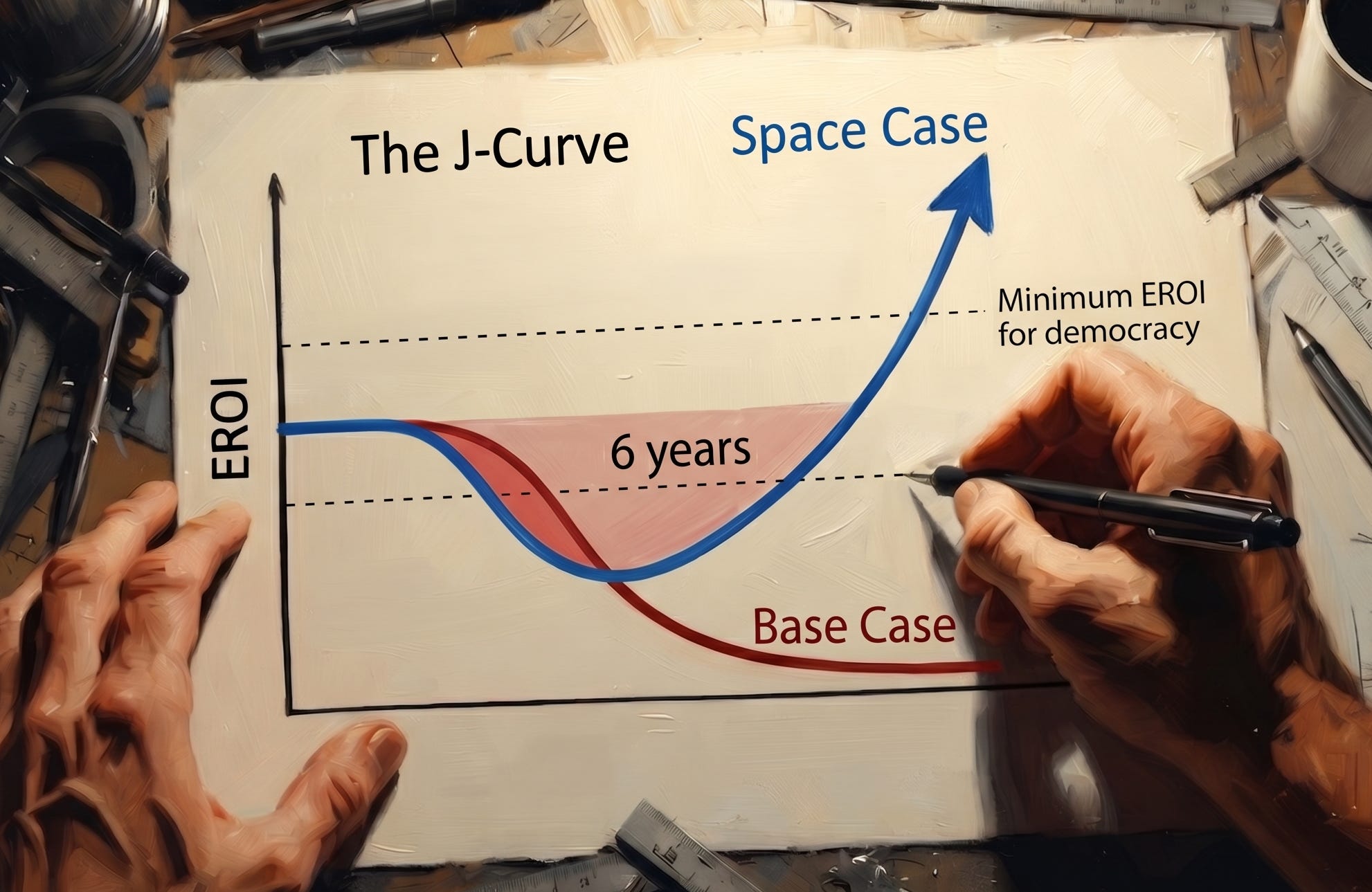
We are in the AI Transition years of 2025-2035. Some —most, I hope— societies will finish this decade with extraordinary new beauty but others will be ruined. My mission with this work was initially just to get my own bearings in this era: what do I prepare for and what do we collectively aim toward? What’s the most important thing I can do to contribute?
The United States and the broader West are entering a decade-long J-Curve — the shape every builder knows, where things get worse before the turnaround — except at civilizational scale. Building independent superintelligence will require something like a trillion dollars, a war-scale energy mobilization, and three to six years of inflation, energy price spikes, activist uproar, espionage, and real strain on social cohesion. But the alternative is the status quo’s trajectory: a country with enough AI to destroy jobs but not enough to rebuild itself, sliding down an energy-surplus curve that historically correlates with deindustrialization and disorder. The difference is whether we’re intentional about the hard times ahead to reach for the upswing.
To develop this perspective, I’ve drafted two longer papers with the help of AI. The Base Case of Benign Neglect and Avoidable Collapse is brutal, holistic look of our current state of America. The J-Curve: EROI Through the AI Energy Transition uses established energy metrics to model social cohesion. At the end of this essay, we get to concrete goals.
My optimism is that western civilization can find a common rallying cry again.
A story about the temptation of easy
One thing about me that surprises people is that I went off the rails as a youth.
I’m talking about more than bad grades. Every kid I hung out with at twelve ended up in jail for drugs or worse. Being a former screwup has its benefits — you live with extra gratitude and a surplus of learning experiences — and lately I’ve been stuck reliving one specific moment from that era. I’m flying down a hill on the back pegs of my friend’s bike, running from someone or something, both of us high as kites, and I make the stupid decision to jump.

The surface level is slapstick: stoned middle-schooler panics at top speed, jumps, hits, tumbles, he's alright folks. But the part that has stuck with me for decades is what I saw while pushing off the asphalt, all exposed skin bleeding: the ground where I stopped rolling was flatter than where I jumped. The hill was almost over. I had given in to fear, tunnel-visioned on the ten feet in front of me, and made the poor decision at the worst possible moment — bailing at maximum speed when riding it out would have cost me nothing.
The moral of the story is that the easy way out is often an illusion. Some situations have no perfect solution and so just riding it out is actually the best course. But to differentiate the easy trap from blindly charging forward, you need a target or at least a modicum of foresight. As a middleschooler, I just had to look 20 feet further to see bottom of the hill. Later as a climber I’d learn to look for the next spot to place protection to catch a fall. As an entrepreneur I’d learn to think in sprints and rests between milestones.
Living in a world with emerging superintelligence is surprisingly similar to that childhood memory riding on the rear pegs of that bike. The tunnel-visioned panic is understandable because the AI transition is a vicious mix of uncertainty and powerlessness. We may as well be on drugs too as every tech company is trying to get into our minds.
Very few of us are at handlebars and those that are at the seat are currently unpopular. But the gnarly truth is that nobody is really steering anyway: The physical shape of the AI situation created the potential energy that has converted to velocity and now it’s a matter of months to a country of geniuses in a datacenter. The exhilaration (“ChatGPT-3 gave me a recipe in the rap style of the Fresh Prince of Bel Air!”) has turned to fear (“How do I feed my family when I get laid off?”). Yet even though we all feel the velocity, very few of us know where we’re going. Why do we need to set off this intelligence supernova at all? How far are we from the bottom? Can’t we just jump off?
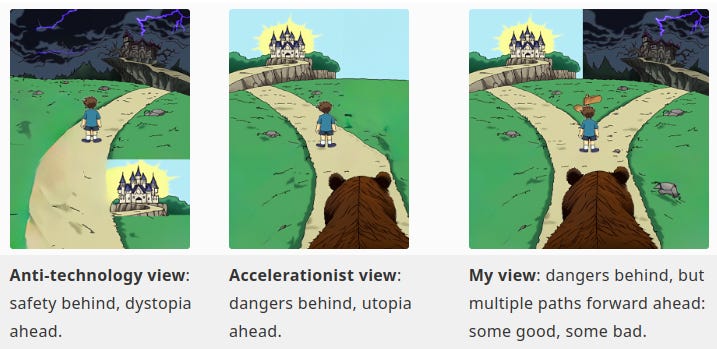
The easy way out trap sounds like let’s cancel every data center, block every mine, protest every power plant, threaten every AI billionaire, move into our bunkers with those who will fit, tell ourselves that running away or protesting or self-medicating fixes it. There is significant foreign money encouraging this panic jump mindset, empowering domestic voices to block AI development under various political banners. Accepting these arguments can be rational if you have incomplete information1. Sometimes smart people get swept up with their own panic jumps of counterproductive action, not because they actually think it’ll do anything positive, but because deep down at least they can feel some control and some solidarity to a group that gives an outlet to their fear.
What has been obviously missing is a shared positive vision of where we are going and why it is worth the hard times ahead.
A serious take on superintelligence
I’ve mostly avoided the public conversation around Artificial General Intelligence (I’ll call it superintelligence because I think that’s more measurable) because it has been crowded and speculative. But now superintelligence is here, is profoundly serious and scaling it is an engineering challenge. The next 3-5 years will decide which countries will have their own superintelligence versus renting it from somebody else.
On Seriousness

Our complex world exists on a one dimensional spectrum ranging from beauty to chaos. When we get the best of our humanity, we create staggering accomplishments of art, sport, science and technology. In a single word: beauty. But when we fail to get the best of ourselves, we are just a massive …
Why does owning superintelligence matter? Because superintelligence is the only input cheap enough and scalable enough to renovate a country that can no longer manage its own institutions. It is labor for infrastructure we can't staff, coordination for systems too complex for our politics, and — critically — defense against adversaries who will have it whether we do or not.
AI is the new gunpowder; a superintelligent force against anything else is rifles versus sharpened sticks. Worse than that, actually, because the side without it would likely be twisted into internal strife before any shot was fired. The optimism we have to earn — it is not guaranteed — is that a world of multiple, broadly adopted superintelligences settles into something like a stable equilibrium, hence the use of the phrase AI Cold War.
I’m going to use two definitions anchor the discussion:
Leopold Aschenbrenner (in 2024’s Situational Awareness) defines the threshold as the automated AI researcher — an AI that can do the work of an Alec Radford, the famously intuitive researcher behind GPT. As of early 2026, we’re seeing the first signs of AI systems discovering and acting on AI-engineering insights toward the moment of recursive self improvement.
Dario Amodei (in Machines of Loving Grace) coined “a country of geniuses in a datacenter”: fifty million Nobel-caliber minds thinking ten times faster than a person.
I know the “what about evil AI” objections; I’ve run those exercises, and good people are rightfully working on those questions. But in June 2026, the two questions that keep me up at night are different:
What happens if we DON’T get superintelligence while others do? The West’s base case is much worse than polite company admits.
What will independent superintelligence cost us? Beyond trillions of dollars: years of inflation, energy price spikes, and a sustained test of social cohesion.
The first challenge for democracies is to steer into the harder path in the short-term.

The physical units of superintelligence
You can measure how fast a human thinks in the same terms as how fast an AI computes. This is the first of many uncomfortable ideas ahead.
An average human thinks at 10 tokens per second (1 token = ~4 English characters), a speed which can easily be attained by a ~$15k computer that could fit under my desk and runs the latest AI systems. That computer might draw a 1000 Watts, the equivalent of running my dishwasher. For $2,500 a year in Massachusetts utility bills (the AI is free because open source LLMs models are good), I can replace myself today in most computer-based jobs with a version that runs 24/7 using architectures that support long-running tasks. That one computer could probably run 10-50 of me.
Now scale to Dario Amodei's vision. Fifty million geniuses thinking 10x faster than me around the clock adds up to roughly a 5-gigawatt datacenter. Meta is building exactly that — Hyperion, in Louisiana — for $100B and targeting first operation by 2028. I think it’s fair to call that superintelligence.
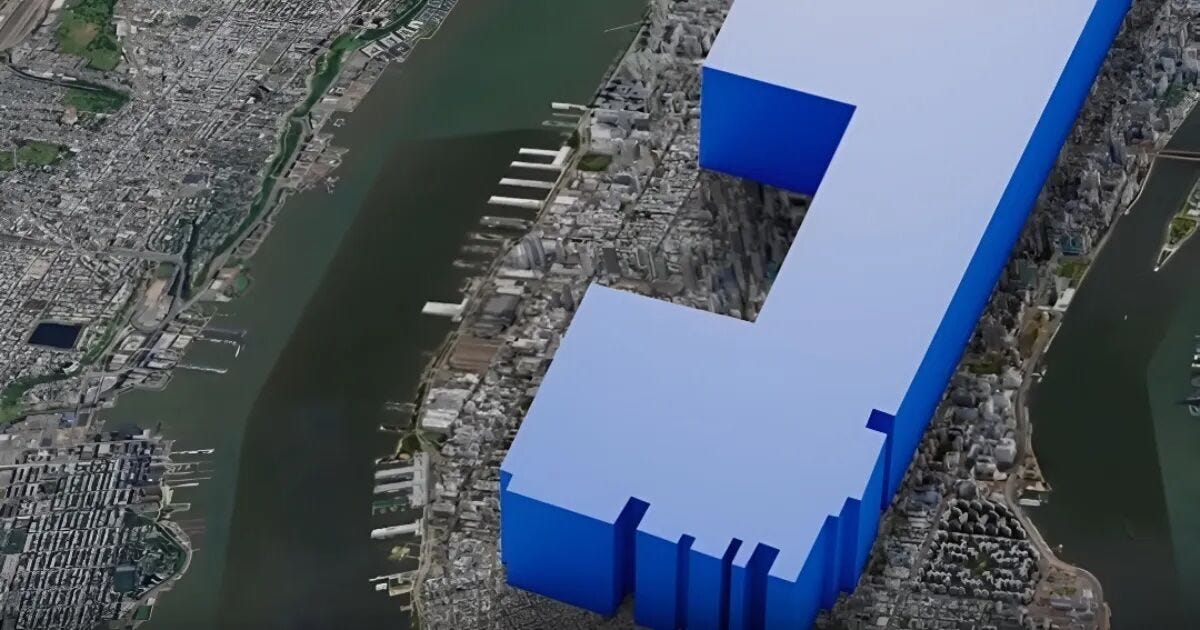
But we can’t stop there. Leopold Aschenbrenner pushes us to imagine the 100GW data center as the AI milestone for national security. It would likely cost a trillion dollars and require coordination on the scale of the Manhattan Project. At this scale, I think it’s easier to stop using Watts and just speak in terms of multiples of the New York City energy budget. Meta’s Hyperion is almost 1NYC. This trillion-dollar cluster, which Aschenbrenner urges us to understand is critical for the future of the United States, is 15 NYCs worth of energy.
Can we produce 15 New York Cities worth of energy in a decade? I couldn’t find anybody doing the analysis I wanted so I just did it myself. I used my friends at Project Innerspace’s Core to Code white paper as the initial framework and then loaded datasets like GEM and FracTracker as starting datasets. I tracked publicized supply against projected demand from 2024 forward, assigned probabilities to every announced datacenter project hitting its stated date, and made deliberately optimistic assumptions on the supply side — no permitting blockages, nuclear arriving on schedule.
Even under those generous assumptions, the US is short about 5 NYCs of power by 2029, and the full decade requires adding 20+ NYCs against a grid that has been growing at half a percent a year. Being short 5 NYCs on an aging grid is hard and being short 20 is untenable — unless we treat this as the mobilization it is.
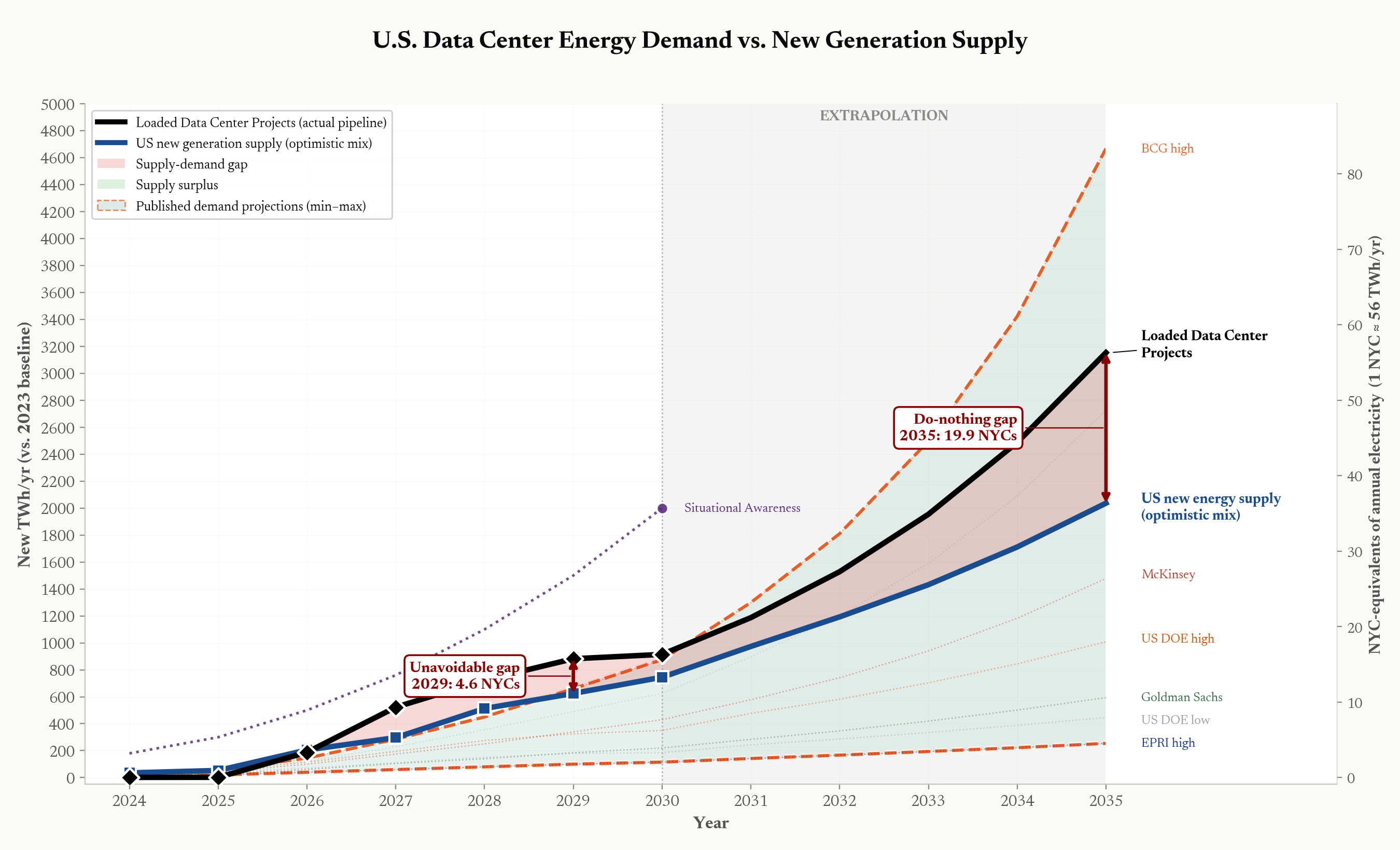
The strain won't be evenly distributed. In the hard years of ~2029, we can expect electricity bills up, layoffs attributed to AI, a visible class of people made fabulously wealthy by the very thing raising your bills, communities fighting data centers over water and noise, kids lost in algorithmic feeds and old fears about evil machines suddenly feeling close to home. That is the best case of hitting the J-Curve's bottom before things get better.
Why would we do this? Because failure —whether an intentional panic jump or not— is worse.
What if the United States does NOT get superintelligence?
Life is a matter of perspective. In the peace we have been blessed with, everything is relative: when wretched people, traffic, politics, and a host of other nuisances intrude on a peaceful life, they can feel like apocalyptic abominations.
But when we are in war, in hardship — in hell on earth — everything is absolute.
-Navy SEAL Sam Alaimo , essay in 2025
My impolite take is that the US faces collapse if it does not get Superintelligence. I compiled a white paper, The Base Case of Benign Neglect and Avoidable Collapse, to unflinchingly look at the USA’s situation. If we do not have the capacity to rejuvenate national systems and defend against the obvious threats, our structural weaknesses and financial interdependencies will certainly compound into chaos. The AI that will destabilize the world can also destabilize entrenched problems with American state capacity, so there is a positive opportunity. But today we stand in the “no mans land” insofar that we have enough AI today to destroy jobs yet insufficient AI to build the USA into a 21st century country.
Three buckets:
Local leadership is poor: 20 of the 25 top cities in the US are broke, and states like Massachusetts face a net outflow of millionaires. Police are operating at an average of 90% staff levels nationwide, but cities like Chicago, Los Angeles and Philadelphia are all short over 1,000 police officers each, but Seattle is the worst at just 848 deployable officers for ~1,500 positions. Follow the professional money: Minneapolis home insurance is up 34% and and the California state home insurer requested a 36% increase in 2025. Investor Michael W. Green created uproar with his analysis that the poverty line needs to be updated from $32k to $100k+ with a “valley of death” that just puts people in debt for incomes in the rough range of $32k-$80k.
The state’s monopoly on violence is being contested within our borders: Washington loses an estimated $520 billion a year to federal fraud and improper payments — a leakage large enough to bankroll violent enterprises that now rival legitimate firms for cash flow and outgun local government. Mexican cartels already operate in almost all 50 states, and they run at corporate scale. Chinese-backed networks built an estimated $4.3 billion marijuana business in Maine alone, while FinCEN flagged roughly $312 billion in suspected Chinese money-laundering transactions between 2020 and 2024. The anti-ICE protests in 2026 have significant ties to foreign money and infrastructure. Violent threats are militarizing on the Ukraine technology curve: the commander of US Northern Command estimating more than 1,000 drone incursions cross the US southern border every month from cartels.
The bill for fiscal irresponsibility is coming due. The dollar’s share of
global reserves has already fallen from 72% in 2001 to 56.3% in 2025 as BRICS builds alternatives. In April 2025, stocks, bonds, and the dollar fell simultaneously in what Deutsche Bank called “rapid de-dollarization.” The world is losing confidence we can get our liabilities in check: When demand for Treasuries thins, the government can no longer finance its deficit cheaply and the CRFB estimates a 2% rise in borrowing costs adds $375 billion a year in interest, a doom spiral.
And on the much more tangible front, it is disheartening to experience AI scarcity in the form of usage throttling or compute queues. There’s no way an engineer can build competitively on meager AI rations in a world where top performers are increasing their token usage at 17% per month2. Here’s a screenshot of what I saw while working on this essay:

AI Progress in the base case without superintelligence won’t have a pivotal, climactic moment of failure — it just quietly won’t work. Western companies like OpenAI and Anthropic will be doomed in a market when their compute offering is uncompetitively priced because their energy supply is uncompetitively priced - there is already a 10x price difference. The US Government will have to subsidize in some way (update: already happening) which will appear like corporate welfare. Developers flow to the lower-cost open source models running inference: subsidized rent of compute means a few will make money of short-term arbitrage of outsourcing superintelligence to foreign black boxes, but the big picture of AI progress will stall. Offshore rentable compute will be subtly subversive: we must always remember Google’s Gemini 1.0 that had been post-trained on social justice essays, producing asian female nazis and black George Washingtons. Code made with AI we don’t control will subtly just not work that well (see Fast16), social cohesion will go down because content will have a hidden bias, and there will be some superficial AI progress but not enough to matter. The USA and the broader West will fail to become superintelligence powers and be overtaken by its own internal disorder.
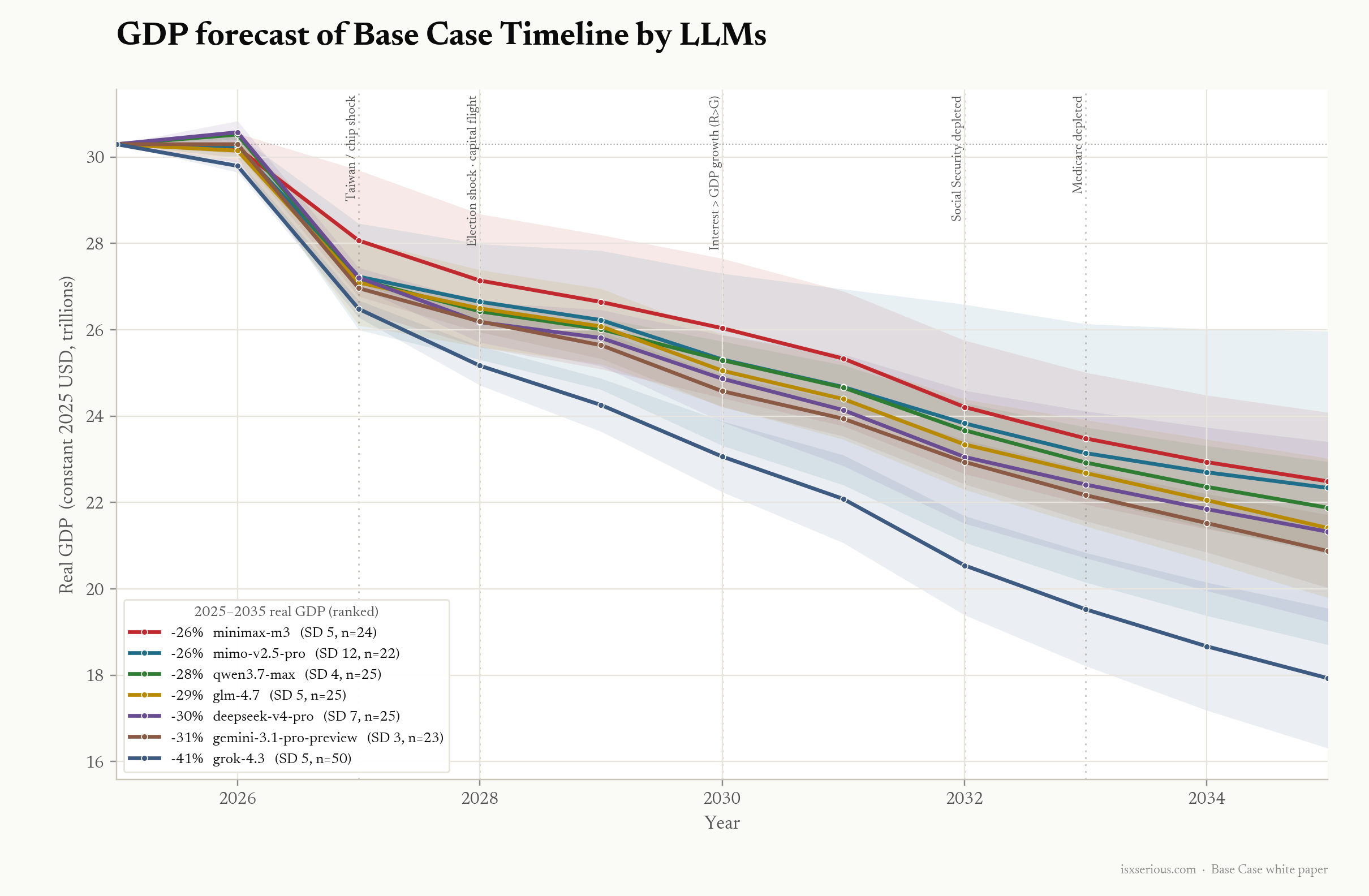
How bad does this trajectory get, numerically? As a forecasting experiment, I fed the Base Case paper into several frontier models and asked them to project real US GDP under the scenario; they consistently returned declines of 26–41% by 2035, against consensus forecasts of +10–20% growth. Treat that spread as an illustration of how differently the scenario reads from the consensus, not as a forecast — the models were reasoning from my own document. But the consensus deserves equal scrutiny: professional forecasting has an endemic normalcy bias, and Americans in particular cannot conceptualize chaos. That blindness is partly why every trend above has been ignored. The flavors of bad ahead look like food prices you can't pay, faceless violence outside your door, and elected officials who know criminal networks watch them sleep. Europe's version is worse.
We are nothing without energy, infrastructure, manufacturing, scientific capacity, and physical safety. Can we measure how close a society is to losing them?

Investing in energy as social currency
Energy is the only universal currency — one of its many forms must be transformed to get anything done. - Vaclav Smil in Energy and Civilization: A History (2017).
When I first started applying thermodynamics to human systems in the original seriousness essay I briefly believed the idea was original to me. Vaclav Smil, Nate Hagens, James Tainter, Tim Morgan, Jessica Lambert and others3 have spent careers on it, and their work supplied exactly what I was missing: metrics and thresholds that separate stable societies from collapsing ones.
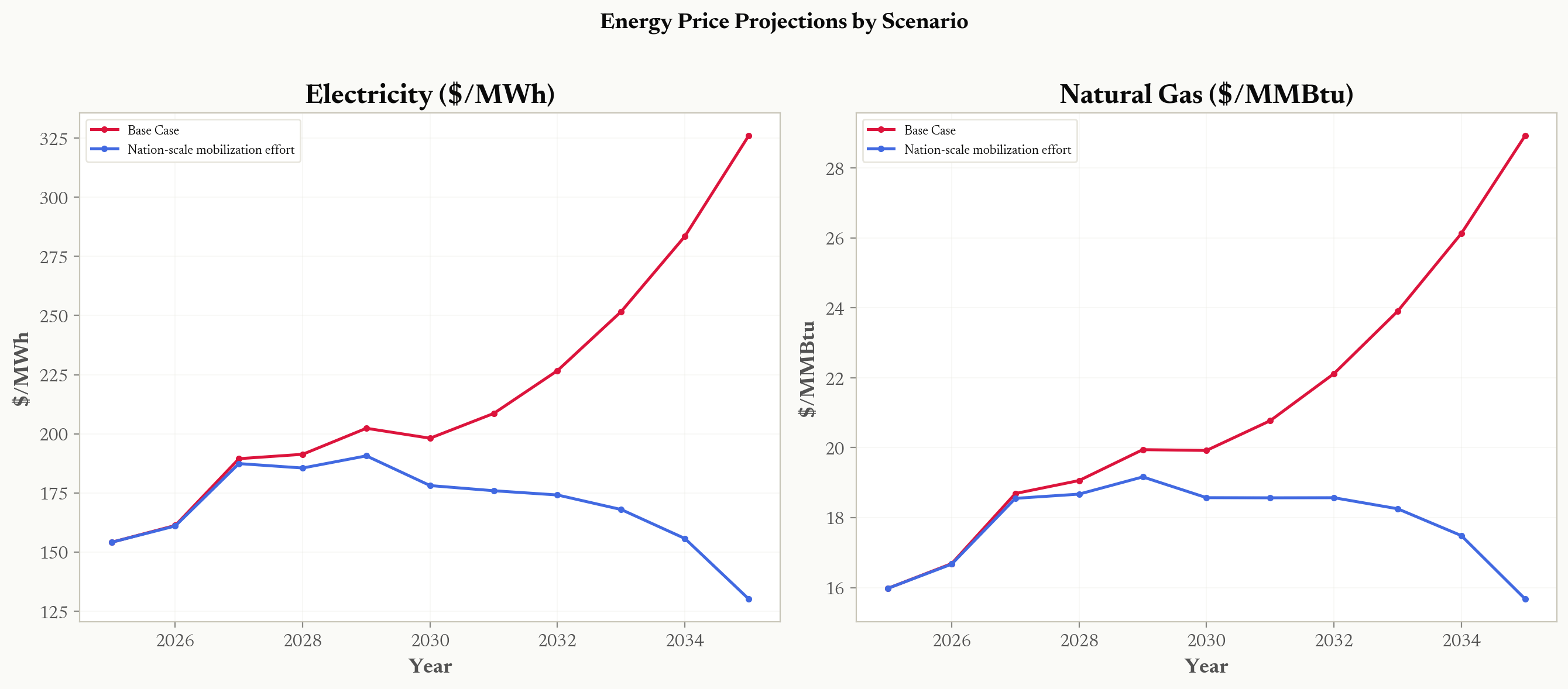
The causality is intuitive: at the individual level, energy shortages drive up costs and scarcity pushes people toward more primal behavior. My estimates show a minimum ~30% energy price increase by 2029 which will hurt working families (37% don’t even have cash for a $400 emergency) and create understandable anger4.
The core metric is Energy Return on Investment (EROI): the ratio of energy delivered to society against energy spent obtaining it. At ~1:1 you have subsistence farming — everything you harvest goes back into harvesting. The early-1900s Texas oil boom ran near 100:1, and that staggering surplus is what built the modern world: the leftover energy is what funds manufacturing, transport, healthcare, universities, and everything else we mean by "civilization."
I wrote The J-Curve: LEROIS Through the AI Energy Transition, 2009–2035 to join the energy calculations from the previous sections to the models built by people who have trained a thermodynamic lens on societies and energy. The LEROIS metric needs some explaining, but even now you can see the J-Curve shape waiting ahead:
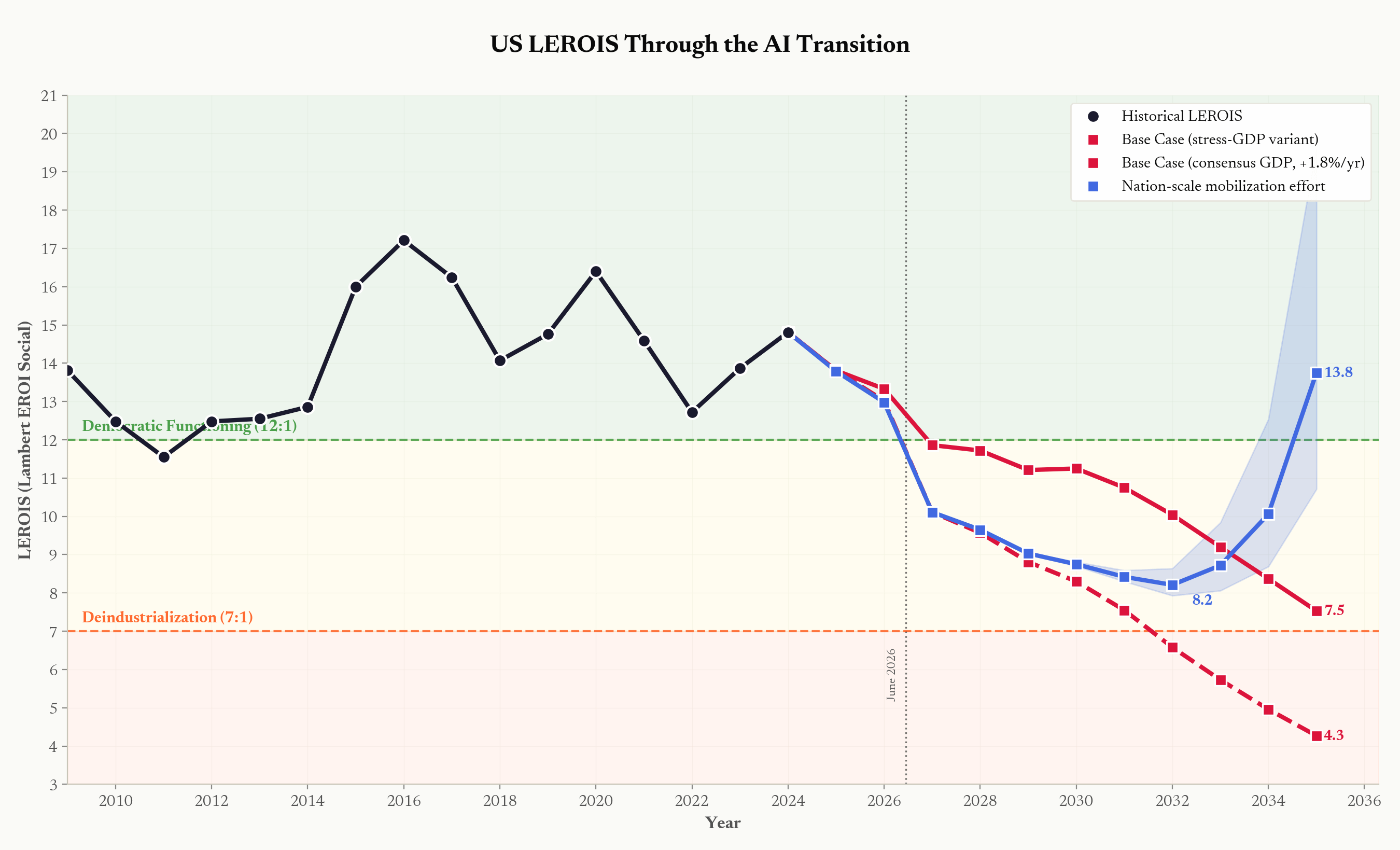
EROI is usually computed per energy project, but it scales to whole societies. The most useful societal version is what I’m calling the LEROIS score (Lambert EROI, Social), adapted from Jessica Lambert, Michelle Arnold and colleagues’ 2014 work. They built a financial-proxy method to estimate societal EROI across nations and found it correlates tightly with the human outcomes we care about: the Human Development Index, female literacy, health expenditure, and income equality.
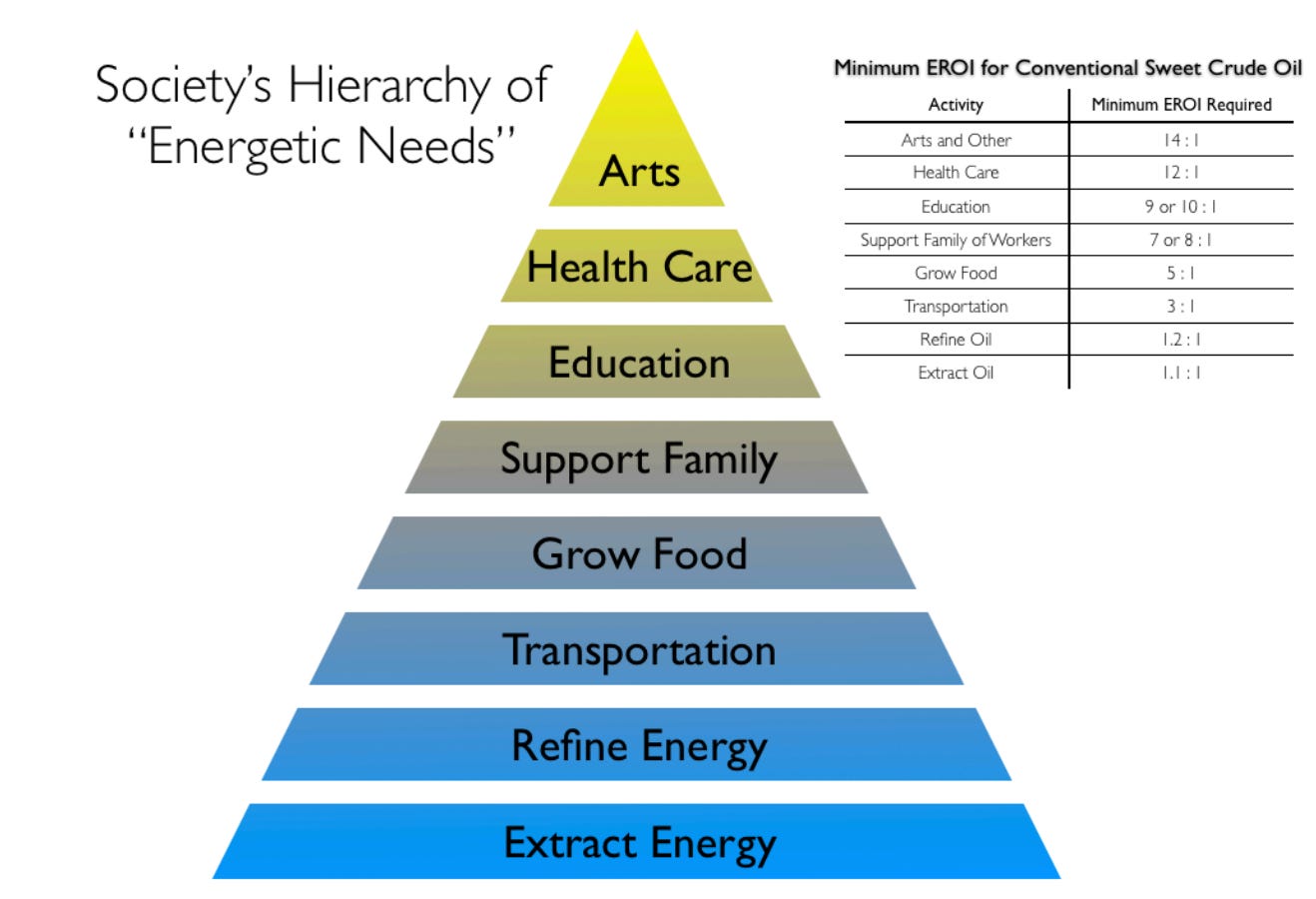
Their important argument is for the equivalent of Maslow’s hierarchy of needs at the societal level, and that EROI is the measuring stick for what’s possible. The exact numbers are fuzzy5 and worth a bit more polishing downstream, but I think the ballpark numbers are good enough to argue the point. Arts require 14:1 or higher. Above roughly 12:1, societies sustain functional industrial civilization — advanced manufacturing, universal healthcare, higher education. Functions visibly degrade in lower EROI and below ~7:1, economies predictably deindustrialize.
Run the West through that lens:
The United States entered 2024 around 14:1 — above the functional threshold, but down from a peak near 17:1 in 2016 and trending the wrong way.
Germany, at ~7.5:1, has entered active deindustrialization after demolishing its nuclear and drowning its coal—BASF began permanently closing European operations after 160 years.
The UK, around 8.5:1, suffered a pension-fund near-collapse and needed £40 billion in emergency energy subsidies (yet continues to block its own energy projects) following the Ukraine war starting in 2022.
The US weathered the same Ukraine-war shock at roughly 12.7:1 — painful 9% inflation, but no structural breakdown. Systems near phase boundaries are exquisitely sensitive to perturbations; systems with surplus shrug off the same shock.
China runs around 8.8:1, but autocracies are able to function at lower surplus than democracies, which must buy consent rather than compel it.
The core question, then: if we’re going to drop everything and sprint to grow the US energy supply from its formerly glacial pace of 0.5% a year to 50% in a decade — how good does the AI have to be to make it pay for itself? The LEROIS calculation uses the GDP-growth calculation and combines energy and AI investments, so it’s worth asking what rates of energy and AI-capability growth would be needed to clear the next decade. The answer is roughly 35% year-over-year growth in the value generated per kWh. That actually matches AI’s progress over the past few years — though forecasting a ~20× multiple by 2035 still feels a little unbelievable. At that level — about $10 of value per kWh from AI, against ~$1/kWh for a human — we’re far past coding and spreadsheets and deep into into drug discovery, chip design, space flight and materials we can’t yet imagine. This urges us to see our scientific enterprise as part of the extraordinary growth we need.
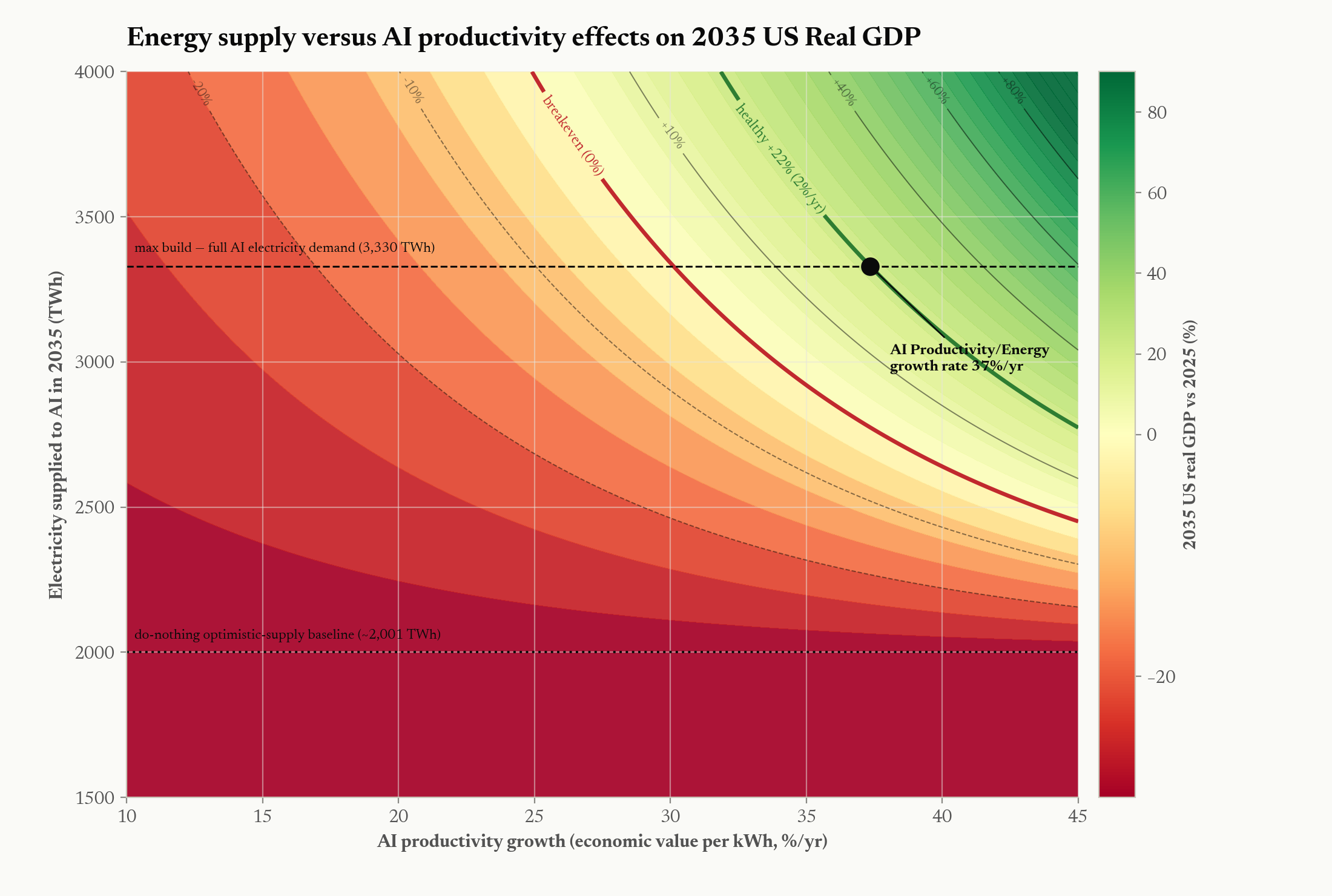
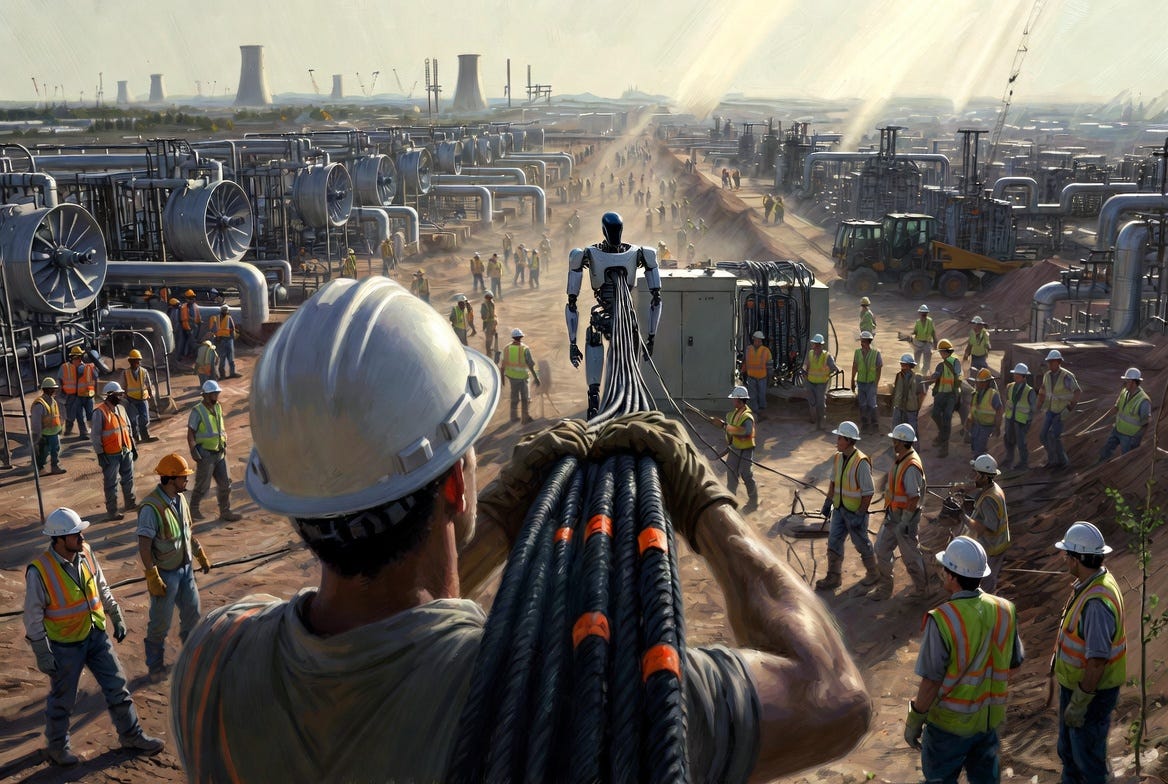
Tractable challenges are empowering and the scoreboard, then, is concrete: 20 NYCs of new power in a decade to keep the US stable. I’ve run the numbers and believe it's achievable with a portfolio along the lines of natural gas (~20%), nuclear (~40%), and enhanced geothermal (~40%). Nuclear at that scale requires permitting reform that does not yet exist; enhanced geothermal has enormous DoE-estimated potential yet almost no deployed gigawatts. I’m personally very excited about geothermal: Jamie Beard has spent years showing that the oil & gas industry — which drills tens of thousands of wells a year — can frack for heat instead of hydrocarbons, unlocking the hundreds of gigawatts the DoE believes sit beneath our feet. The people and the technology exist today. The binding constraint is whether we let the builders build, which is to say the binding constraint is us.
The Civilizational Spaceship
“Every year we get closer to AGI everybody will gain +10 crazy points.”
- Sam Altman 2024 (link)
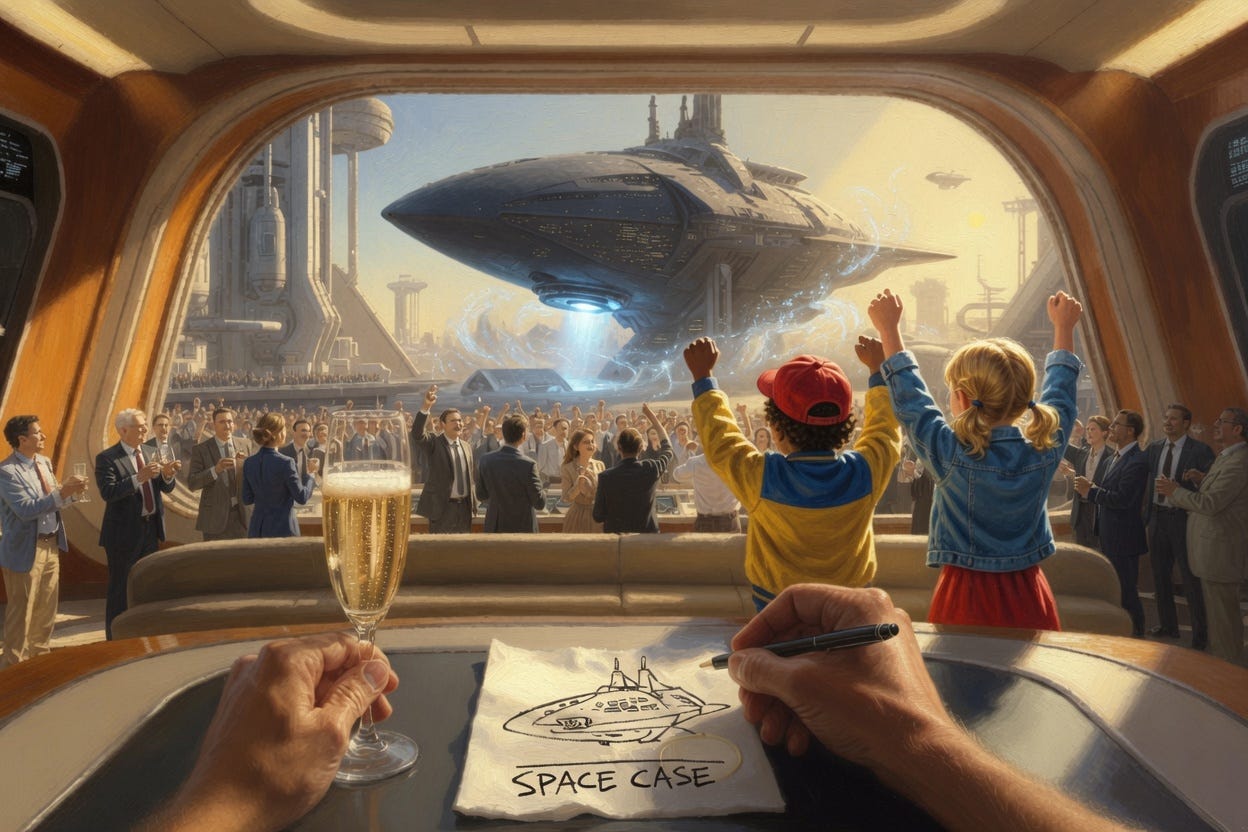
We are getting superintelligence now, so David Deutsch would say we’re at the beginning of infinity. Our imagination and ambition become our limiting factors — if AI just makes our modern world more efficient then wide-scale job loss is inevitable. We have to imagine a much bigger world in the post-AI reality: new frontiers in space, new frontiers the gigascale here on earth and new frontiers at the quantum scale. If we really do get on the 35% annual value-per-energy increase for AI-powered systems, then it’s not unreasonable to start imagining motherships in our lifetime.
A hulking spaceship that carries a civilization is a fitting quasi-literal metaphor. Building superintelligence and a launching mothership share many attributes m such as the trillion-dollar scale of the effort, the short-term uneven reward and the strangeness of the mission. Then there is the competitive bottleneck element: The first civilization to get a mothership into orbit could turn around and blow up all other spaceships while sitting in their launchpads on earth. More banal but no less pernicious, there will also be nasty attempts at espionage and sabotage because successfully launching a spaceship a is a weak link problem (one tiny detail can destroy the whole effort). At least with a spaceship you have the incredible moment of takeoff and the visceral sense of awe of what a collection of humans are capable of.
It’s easier to appreciate the all-hands-on-deck effort to launch a mothership than to stumble toward vague “superintelligence.” We’re putting a skyscraper into space! Imagine the countless shifts of construction providing power and structure, the coordinated frontier science teams translating the theoretical to experiment, the public demonstrations shared throughout the population as new Star Trek propulsion systems begin to enter our reality. When the Empire State Building was under construction, the whole city tracked the progress day-by-day: the number of completed stories in the previous day was announced in the paper.
The best-case scenario is at least two motherships make it orbit at the same time. In this game theoretic position, neither of which want to risk destruction yet neither can control the chokepoint of launch back on earth. Space is vast and abundant to all, we just have make sure this bottleneck is left open.
Earning the default-positive outlook

I’ve wondered why I’ve ruminated so much about that memory of jumping off that bike. It felt so stupid in the moment and so obviously shameful when I had to craft a weak false narrative to my parents that evening. But I remember that experience as one of my turnaround moments.
When I assembled the Base Case material, I felt the same recognition: a society tunnel-visioned on the next ten feet, full of unforced errors and statecraft failures, tempted everywhere by the easy jump — cancel every datacenter, block every mine, protest nationalism, bunker up, self-medicate, mistake the feeling of control for control. Some of that response is even rational under incomplete information; solidarity in fear is still solidarity. We have to grow to our next form.
That young version of me on the bike lived in a world with a positive outlook for the future. It’s fair to say that default-positive outlook has faded in recent years, both by unforced errors and subtle external interventions to demoralize. I won’t be demoralized: I had a second chance then and we have a second chance now. The path to a shared positive outcome starts with understanding the magnitude of the opportunity in front of us — the chance to show ourselves how good we really are — and then making the serious, unglamorous, years-long push to the upswing of the J-Curve.
Or if you live next to the current generation of data centers. Clearly compensation is the right answer for people who live next to the constant loud noise.
To get 17%, I used April 2026 data from Jellyfish which has a 90th percentile developer using 380M tokens/month. I calculate a pre-AI human’s token output per month 10 tokens/s × 3,600 s/hour × 60 hours/week × (52 weeks ÷ 12 months) ≈ 9.36M tokens/month. Using intermediate data points this turns into a ~17% month-over-month increase since 2024.
Shoutout to Alice Friedemann, a 71yo who actively blogs on the topic too.
It’s worth pointing out that energy prices in poorly-managed states like Massachusetts have already increased ~50% since 2020.
There are countless variants of EROI and several ways to compute each one of those: I was unable to replicate the exact numbers in the literature so I just did what makes most sense to me, and my numbers vary 30-50% from original numbers published by Lambert, Hall and colleagues. Details in the EROI paper.
*Maybe* the severity of the J-curve bottom will be mitigated by some basic breakthrough that cuts the cost of pure scaling of the current kind of model architecture? I'm thinking back to the human genome project, where between NIH and Celera, easily a billion or two $ were spent to get the first genome. The cost now is arguably <$1000, and was at <$10,000 even 15 years ago, once the Solexa (now Illumina) technology was discovered and implemented at scale. That of course doesn't argue that we shouldn't have spent the $1-2B using old Sanger/ABI technology; the one was required for the other to appear. But given that the "ASI problem" is ~1000x more costly, it seems like the energy constraint the interested parties will run into (failing a Manhattan Project-scale effort of the type you rightly advocate) will force an acceleration in creative thinking, and some new form of inference, or something, will be discovered, that can outclass the current LLM gradient descent/attention mechanisms. Once hopes?